In chess there are situations that occur during the game that coincide with some theorems of mathematics, such as the famous rule of the square is no more than a practical application of the theorem of Pythagoras or the geometric definition of distance. In game theory, chess is considered a zero-sum game, and some go further by stating that for any position that can occur within the board there is a mathematical function capable of evaluating that position.
Apart from the practical game, there is also a close relationship between these two areas. Who will not have read or heard the famous legend of the inventor and King, and the form of payments in grains of wheat proposed by the first, whose geometric progression within the chessboard reaches an impressive amount.
Not in vain has chess attracted the attention of famous mathematicians over time. The mathematician Carl. Gauss was interested in solving the problem of the 8 ladies. So also Leonard Euler, raised and solved the "problem of the movement of the horse" (to walk with the horse by all the squares of the board without going twice in any of them), besides proposing solutions inside the chessboard for the construction Of the magic squares of order n. It may seem incredible to the reader, but building the magic square gives the solution to the horse's journey!
Marcel Rovira
martes, 16 de mayo de 2017

lunes, 8 de mayo de 2017
Es pot disfrutar d'una pel·lícula amb bastantes mates?

Aixó enspot ajudar a entendre per exemplen en l'Auditori Nacional de Catalunya, que el sostra; de tal forma que aplican la succesio de Fibonacci ens perment que el so s'escolti bé desde qualsevol lloc de l'auditori.

També en altres coses es pot trobar, com en fenomens meteorològics:

O en política:

Albert Camps.
L'altre dia feien "El còdig Da Vinci" a la televisió, em vaig parar un moment i vaig pensar lo bé que m'ho vaig passar mirant aquesta peli, portant així bastantes mates. En un moment apareixen uns números que posteriorment els hi serveixen per averiguar un antic secret que a permés ocult miles d'anys.
Aquest números són: 1, 2, 3, 5, 8... Aquest números partenixen a Fibonacci i funciona així:
Tu comenses per l'1 i segueixes pel 2 un cop tens l'1 i el 2 els sumes que donen 3, després al 3 l'hi sumes el 2 que dona 5 i al 5 l'hi sumes el 3 que dona 8 i així succsesivament.
Això es sol trobar en forma d'un cargol:
Tu comenses per l'1 i segueixes pel 2 un cop tens l'1 i el 2 els sumes que donen 3, després al 3 l'hi sumes el 2 que dona 5 i al 5 l'hi sumes el 3 que dona 8 i així succsesivament.
Això es sol trobar en forma d'un cargol:
Aixó enspot ajudar a entendre per exemplen en l'Auditori Nacional de Catalunya, que el sostra; de tal forma que aplican la succesio de Fibonacci ens perment que el so s'escolti bé desde qualsevol lloc de l'auditori.
També en altres coses es pot trobar, com en fenomens meteorològics:
O en política:
Albert Camps.
martes, 2 de mayo de 2017
poligon
Triangle: polygon with three sides
Quad: polygon with four sides


Pentagon: polygon with five sides
Hexagon: polygon with six sides
Heptagon: polygon with seven sides
Octagon: polygon with eight sides
Enneagle: polygon with nine sides
Decagon: polygon with ten sides
Undecagon: polygon with eleven sides
Dodecagon: polygon with twelve sides
And so on…
Equilateral: if they have all their equal sides
Equiangle: if you have all sides equal
Regular polygon: if all sides are equal and equidangle (all angles equal)
Irregular polygon: it has both its sides and its unequal angles.
Convex: all interior angles are less than 180 °. By another method, it will be convex if for any pair of points in the polygon, the segment joining them is inside the polygon.
Concavo: some interior angle is more than 180º. Unlike the convex, in the concaves there is a pair of points of the polygon that the segment that unites them is outside the polygon.
Imple: no side of the polygon intersects with another

 Complex: at least a couple of sides are cut
marcel rovira
martes, 25 de abril de 2017
Plane geometry. Etymologically, from the Greek "geo", earth; "Metrein", to measure, is the branch of mathematics that deals with the study of geometric figures in the plane. In general, in its elemental and classical form, the geometry focuses on metrical topics such as the calculation of the area and perimeter of flat figures and the area and volume of solid bodies. Other approaches to geometry are analytic geometry, descriptive geometry, topology, space geometry, with four or more dimensions, fractal geometry, ineuclide geometries.
Marcel rovira
Marcel rovira
martes, 18 de abril de 2017
martes, 29 de noviembre de 2016
Hello Pipioluu!!!
Last art class, was abaut maths (HORROR!!!) abaut impossible figures, it strange figures have a trick to do:

(Escher two)
-All the lines have to be 30º. It's more easy that you think. We have right triangle and a set square:

(Right triangle) (Set square)
How to make paralel lines

It's in catalan but I'm going to translate:
1. Fit the right triangle to the top.
2. Put the set square next to the right triangle, like in the photography.
3. Grab the right triangle and muve up or down the set square
Good week
Sunni
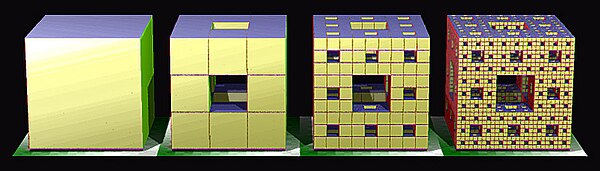
LA ESPONJA DE MENGER
Alguien había escucha alguna vez hablar sobre la esponja de Menger?
La esponja de Menger es un fractal en forma de cuba.Se descrivió por primera vez en el 1926, por Karl Menger mientra exploraba el concepto de dimensió topológica2
La esponja tiene una superficie infinita y al mismo tiempo encierra su volumen es cero.
La construcción de la esponja de Menger se define de forma recursiva:
1-Comenzamos con un cubo.(primera imagen).
2-Dividimos cada cara del cubo en 9 cuadrados. Este se subdivide en 27 cuadrados más pequeños, como le sucede al cubo de Rubik.
3-Eliminamos los cubos centrales de cada cara (6) y el cubo central (1), dejando solamente 20 cubos (segunda imagen).
4-Repetimos el prceso 1, 2 y 3 para uno cada uno de los 20 cubos menores.
Y este es uno de los muchos fracteles que se conocen hoy en día (más adelante os explicaré otros fracteales).
Albert C.
Suscribirse a:
Entradas (Atom)